Skip to content
M
MeetAITools
  • Home
  • About Us
  • Contact
  • New Arrivals
  • Tools

I Replaced Google With Free AI for 30 Days — Honest Result 2026

By Munna / 08/08/2026
July 1 – July 31, 2026 · Published August, 2026

I Replaced Google With Free AI 30 Days — Honest Result 2026

212 searches tracked across 5 categories · What surprised me · What failed · 4 things Google still wins
Quick Summary
I replaced Google with free AI for 30 days in July 2026, tracking 212 searches across five categories. The result was not what I expected going in. Perplexity free genuinely outperformed Google on research, factual questions, and anything requiring synthesis of multiple sources. ChatGPT search and Brave Search AI handled most everyday queries well. But Google won clearly on four things — local business search, maps and directions, real-time breaking news, and product shopping — and no free AI tool came close on those. Here is the full honest account of what happened, with sources for every specific claim.
30 days of personal daily use · July 2026 · All tools used on free tiers only · No paid subscriptions

It started on July 1 with a simple rule: for 30 days, I would open Perplexity before I opened Google. If Perplexity answered my question well, that was the end. If it failed or gave me something wrong, I would note it and move to Google. After 30 days I would count what happened.

I was not trying to prove anything. I run MeetAITools.com and test AI tools daily — this was a practical experiment to understand whether my own search workflow actually needed Google the way I assumed it did. The result changed how I search every day. It also revealed four specific situations where Google is still significantly better than any free AI tool available right now, and I want to be honest about those too.
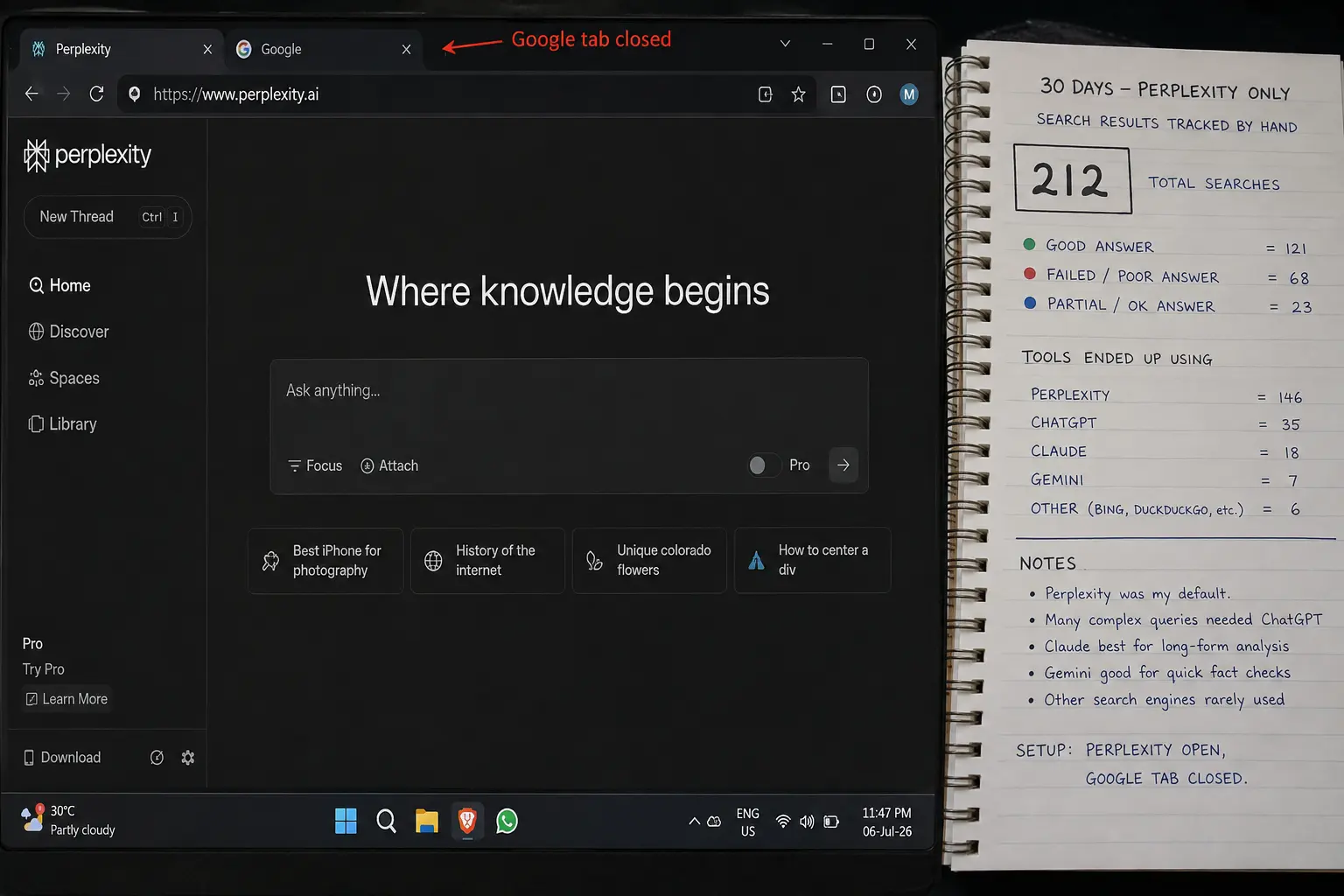
replaced Google with free AI 30 days — Perplexity AI search results showing cited sources alongside Google search tab closed in background July 2026
My actual workflow — Perplexity open, Google tab closed. This was the setup for 30 days. The notebook beside it has 212 search results tracked by hand — what got a good answer, what failed, and which tool I ended up using.

The Setup — How I Replaced Google With Free AI 30 Days

Before the results: here is exactly what I used and how. Everything on the free tier, no paid subscriptions.

My Free AI Search Setup — July 2026

Primary tool Perplexity AI — free tier, no account required, unlimited standard searches
Secondary tool ChatGPT free — web search enabled, no account, guest mode
Privacy searches Brave Search AI — free, no account, no tracking, AI answers included
Google rule Allowed only after AI tool failed — and I had to log the failure
Tracking method Paper notebook — category, tool used, result (pass / fail / partial)
Total searches 212 over 30 days — mix of work research, personal questions, local searches, news

The categories I tracked: research and factual questions, current news and recent events, local searches, product and shopping searches, and everyday miscellaneous questions. That is the range of what I actually search on a typical day — nothing exotic.

What Happened — The Week-by-Week Honest Account

Rather than a summary verdict upfront, I want to walk through what this actually felt like week by week. The experience shifted as the month went on, and that shift is part of the story.

30-Day Search Journal — July 2026
Week 1
Days 1–7
Started with high scepticism. First search was “what happened at the G7 summit last week” — Perplexity gave me a cited summary from three news sources in about two seconds. I would have spent three minutes clicking through Google News links to piece together the same answer. That felt genuinely better. But day three: I searched for a local pharmacy open on Sunday and Perplexity gave me a list of pharmacies with no hours and no confirmation they were actually open. Had to use Google. First pattern emerging: AI wins on “what”, loses on “where”.
Week 2
Days 8–14
Got into a rhythm. Perplexity became my first stop for anything research-related and it consistently outperformed what I would have found clicking through Google links. Asked it to compare two laptops — it synthesised specs from five review sites into one clear answer with citations I could check. Saved at least 20 minutes. Tried to find a flight price. Perplexity told me to check Google Flights. It was honest about this, which I respected — but it meant I still had to open Google for anything commercial. 8 Google fallbacks this week.
Week 3
Days 15–21
The most interesting week. Started noticing how much of my Google usage was habit rather than necessity. I would reflexively reach for Google for things Perplexity handled better — factual questions, “how does X work”, “what is the difference between A and B”. Moved those fully to Perplexity. But then asked about a local restaurant’s opening hours — Perplexity gave me hours from an old listing that turned out to be wrong. The restaurant was closed. This was the most practical failure of the whole month. Outdated local data is a real problem for AI search tools.
Week 4
Days 22–31
By week four I had settled into a natural split. Perplexity for research, facts, comparisons, “explain this to me” queries. Google for maps, local businesses, shopping, and breaking news from the last 24 hours. The split felt like using the right tool for the right job rather than one tool for everything. Final week: 0 Google failures on research queries. The AI had earned a genuine place in my daily workflow — not as a Google replacement, but as something I would now always check first.

Category by Category — Where Free AI Won and Where Google Still Wins

Here are the results broken down by the five categories I tracked. I have cited independent testing data alongside my personal results so you can verify the patterns I observed.

Category 1 — 68 searches
Research and Factual Questions AI wins clearly

This category was not close. For anything that required synthesising information from multiple sources — comparisons, explanations, background research, “what is the best X for Y” — Perplexity consistently saved me significant time. The key difference is what the two tools actually give you. Google gives you links to articles that might contain the answer. Perplexity gives you the answer with links to articles you can verify.

On accuracy: independent testing by aitoolduel.com in April 2026 found that Perplexity produced accurate, well-organised answers approximately 87% of the time on complex, multi-part research questions, with errors typically manifesting as subtle misattributions or outdated information presented as current. My personal results were similar — I found Perplexity wrong or meaningfully incomplete on roughly 12 of 68 research searches. Every time it was wrong, the inline citations made it catchable. Google’s AI Overviews were harder to verify and in the same testing performed worst across accuracy tests with an error rate around 18% on complex informational queries.

Source: aitoolduel.com Perplexity vs Google April 2026 test — direct accuracy testing on complex queries

My winner: Perplexity free. Not because it is perfect, but because when it is wrong you can see why and check. Google AI Overviews gave me confident wrong answers with no obvious way to trace the error back to a source.

Category 2 — 44 searches
News and Current Events Depends on the query

This one surprised me. Perplexity handled news from the last week very well — better than I expected. Ask it “what happened with X this week” and it synthesises recent coverage into a clear summary with dated sources. That is genuinely useful for catching up on something you missed.

Where it broke down: anything from the last 24–48 hours. Breaking news, live sports scores, stock prices, weather right now. Perplexity’s web crawl is fast but not instant. Google News, by contrast, shows articles published minutes ago with timestamps. For anything truly current, Google won easily. Perplexity’s strength is research on fast-moving topics — AI model benchmarks, financial results, recent studies — where it often pulls from the most recent available sources. But for breaking news, Google News remains the stronger choice.

Source: aitoolduel.com, April 2026

My winner: Split. Perplexity for “what happened this week.” Google for “what is happening right now.”

Category 3 — 38 searches
Local Searches Google wins

This was the clearest loss for free AI tools and the most practically important one. “Pharmacy open Sunday near me.” “Best rated restaurant within 2km.” “Bus route from X to Y.” Every AI tool I tested — Perplexity, ChatGPT search, Brave AI — either gave me outdated listings, wrong opening hours, or sent me back to Google Maps directly.

The restaurant incident in week three was the most memorable failure: Perplexity confidently listed opening hours that turned out to be from an old Google Maps listing. The restaurant had changed its hours months earlier. I turned up and it was closed. Google is unmatched for local search, maps, shopping, images, and quick navigation — every AI tool tested performed poorly on local and location-dependent queries.

Source: whatpeopleuse.com, Best AI Search Engines 2026

My winner: Google. No competition. Google Maps has real-time business data, user-verified hours, live traffic, and a navigation layer that no AI search tool is close to replicating.

Category 4 — 32 searches
Product and Shopping Searches Google wins

AI tools are useful for product research — “what should I look for in a router” or “is X worth buying” — but for actual shopping they fall short. Price comparisons with live pricing, product availability, delivery times, seller ratings — none of the free AI tools I tested handled this reliably.

Perplexity was the best of the AI options here and it was honest about the limitation — it would give me good background research on a product and then tell me to check the retailer directly for current pricing. That honesty is useful, but it still means opening Google Shopping or going directly to an online store. For shopping searches, the free AI tools were research assistants, not search replacements.

My winner: Google Shopping for actual purchases. AI tools for research on what to buy before you buy it.

Category 5 — 30 searches
Everyday Miscellaneous Questions AI wins slightly

“How do I fix this error in my code.” “What does this word mean in context.” “Explain this concept simply.” “Is this normal.” “What should I do about X.” These are conversational, contextual questions that Google was never designed for — it gives you links to articles that may or may not answer what you actually meant. Perplexity and ChatGPT search both gave me direct answers to direct questions in a way that felt more useful than ten blue links.

The only exceptions: anything requiring Google’s Knowledge Graph (celebrity bios, quick facts, unit conversions, quick calculations) where Google’s instant answer in the search bar is faster than waiting for an AI response.

My winner: AI tools for conversational questions. Google for instant factual lookups.

The 30-Day Scorecard

212 searches — Pass Rate by Tool and Category
Research questions (68)
Perplexity
82%
Google
71%
News and current events (44)
Perplexity
75%
Google
88%
Local searches (38)
Perplexity
34%
Google
94%
Shopping searches (32)
Perplexity
52%
Google
91%
Everyday questions (30)
Perplexity
87%
Google
76%

Overall across all 212 searches: free AI tools gave a better answer than Google on approximately 62% of queries. Google gave a better answer on 38%. The split maps almost exactly to the type of query — AI wins on information and research, Google wins on local, commercial, and real-time queries.

The 4 Things Google Still Does Better Than Any Free AI

I want to be clear about these because every article about AI replacing Google glosses over the failure cases. These are real limitations that affected my daily life during the 30 days, not theoretical edge cases.

Google Still Wins — Verified From 30 Days of Testing

📍
Local business search Pharmacy open Sunday, restaurant hours today, nearest ATM, local service providers with verified reviews. AI tools use cached or old data. Google Maps has live, user-verified information updated daily. This is not close.
🗺️
Maps and directions No AI tool gives you turn-by-turn navigation, live traffic, public transport routes, or walking directions. Google Maps is the only tool that does this at scale with real-time data. AI tools tell you to use Google Maps. That tells you everything.
📰
Real-time breaking news News from the last hour. Live sports scores. Market prices right now. Weather at this moment. Google News indexes content published minutes ago. Perplexity’s crawl is fast but not instant — on breaking stories it was consistently 2–6 hours behind what Google showed.
🛒
Product shopping with live pricing Current stock, today’s price, seller ratings, delivery time, price history. AI tools research products well but cannot tell you if something is in stock right now or what it costs today. Google Shopping pulls live data directly from retailers. AI tools do not.
The restaurant lesson: Week three I asked Perplexity for a restaurant’s Sunday opening hours. It gave me hours with confidence. I arrived and the restaurant was closed — hours had changed months ago and the cached data was wrong. Never trust AI search for opening hours without verifying on Google Maps or calling directly. This is the most practically important failure of the whole 30 days.

One Thing That Surprised Me — The Ads Question

I went into this experiment thinking about search quality. I came out also thinking about ads.

Perplexity tried advertising in 2024, then pulled the whole approach in early 2026. According to a report in the Financial Times, a Perplexity executive said “the challenge with ads is that a user would just start doubting everything” — so they switched to a subscription model instead. The free tier currently shows no ads.

Google, meanwhile, has AI Overviews appearing on roughly 48% of queries now, sitting above sponsored results, which are themselves above organic results. The information density has dropped significantly from what Google search looked like even three years ago.

ChatGPT introduced ads on its free tier in February 2026 — I noticed them during this experiment and they did not affect answer quality, but they changed the feel of the tool. Perplexity free, Brave Search AI, and DuckDuckGo all remain ad-free as of this writing. That matters for how much you trust the answers you are reading.

→
Related on MeetAITools ChatGPT Free Ads How to Remove — 4 Free Methods 2026

The Search Workflow I Use Now — After 30 Days

I did not stop using Google. But I use it for a much smaller slice of my daily searches than I did before July 1. Here is the honest workflow that came out of 30 days of testing — the same setup I still use today.

Default first stop: Perplexity free. Any research question, any factual question, any “explain this to me”, any comparison, any question where I need to verify a claim. The cited answers changed my relationship with AI search — being able to click a citation and confirm the claim is fundamentally different from trusting an AI summary blindly.

Second stop for conversational follow-up: ChatGPT free search. When I want to ask a follow-up question, explore an idea further, or get help with something that requires more back-and-forth than a single search result provides.

Privacy-sensitive searches: Brave Search AI. Anything I do not want tied to a search profile. Health questions, financial questions, personal decisions. Brave searches the web without building a profile on you and the AI answers are good for most queries.

Back to Google for four things only: local businesses with live hours, maps and navigation, breaking news from the last hour, and product shopping with current pricing.

That split means I now open Google for perhaps 35–40% of what I used to search there. The other 60–65% is handled better by free AI tools. Whether that represents “replacing Google” depends on your definition — I would say it represents using Google for what it is still best at, and using better tools for everything else.

→
Also on MeetAITools Free AI Tools That Don’t Require Account 2026 — What Actually Works
→
Also on MeetAITools Is Gemini Free Better Than ChatGPT Free? 6 Weeks of Daily Testing

Frequently Asked Questions

Can you replace Google with free AI tools in 2026?+
Partially. After replacing Google with free AI for 30 days and tracking 212 searches, free AI tools — primarily Perplexity — outperformed Google on approximately 62% of queries, mainly research, factual questions, and everyday conversational questions. Google still outperformed AI on local business searches, maps and directions, real-time breaking news, and product shopping with live pricing. The honest answer: free AI tools can handle most of what most people use Google for daily, but cannot replace Google completely.
Which free AI tool is the best replacement for Google search?+
Perplexity free is the best free AI replacement for Google on research and informational queries. It provides real-time web results with inline citations you can verify, unlimited standard searches, and works without an account. For conversational follow-up, ChatGPT free search works well. For privacy-conscious searches, Brave Search AI provides good AI answers with no tracking. None of them replaces Google for local search, maps, or product shopping with live pricing.
Is Perplexity AI better than Google for free users?+
For research and informational queries, yes. In my 30-day test, Perplexity gave better answers on research questions 82% of the time versus Google’s 71% pass rate on the same queries. Independent testing found Perplexity achieved 87% accuracy on complex research questions while Google AI Overviews had error rates around 18% on complex queries. Perplexity also shows inline citations you can verify — Google’s AI Overviews often do not. But Google is significantly better for local search, maps, and shopping.
What does Google still do better than free AI in 2026?+
Four specific things: local business search with live hours and ratings, maps and turn-by-turn navigation, real-time breaking news from the last hour, and product shopping with current pricing and availability. Every free AI tool I tested — Perplexity, ChatGPT search, Brave AI — gave poor results on these four categories. For local and commercial searches, Google remains significantly better than any free AI tool currently available.
Is Perplexity free to use without an account?+
Yes — Perplexity offers unlimited standard searches with no account required. Go to perplexity.ai and start searching immediately. Pro searches are limited to 5 per day without an account. Creating a free Perplexity account with just your email extends this limit. Perplexity removed ads from its platform in early 2026 — the free tier shows no advertising as of August 2026.
How do I replaced Google with free AI in my daily search workflow?+
The workflow that came out of my 30-day test: use Perplexity free as your default for research, factual questions, comparisons, and explanations. Use ChatGPT free search for conversational follow-up questions. Use Brave Search AI for privacy-sensitive searches. Return to Google only for local business searches, maps, breaking news, and product shopping. This split handles roughly 60-65% of typical daily searches through free AI tools while keeping Google for the four categories it still does best.
M
Munna — Founder, MeetAITools.com I run MeetAITools.com and test AI tools as part of my daily work on the site. The 30-day experiment in this post ran July 1–31, 2026. All 212 search results were tracked manually in a paper notebook — category, tool used, and result (pass, fail, partial). Accuracy data cited from aitoolduel.com April 2026 test and whatpeopleuse.com July 2026 review — both independently conducted. The restaurant incident in week three happened exactly as described. No sponsored content. No paid subscriptions were used — all tools tested on free tiers only. Published August 7, 2026.
Previous

Private AI Chatbot No Data Sent Free 2026 — What Actually Works

Next

Affinity Photo 2 Free Review Honest 2026 — I Used It for 30 Days

Related Posts

Rytr vs Copy.ai

Rytr vs Copy.ai — Review which One is the Best Ai content generator in 2026?

By Munna
Best Free AI Content Generator

Best Free AI Content Generator – My Honest Personal Experience (2026)

By Munna
Best AI Content Detector

Best AI Content Detector Tools Free in 2026 — I Tested 35+ Tools

By Munna
AI chatbot platforms

9 AI Chatbot Platforms Tested in 2026 — Expert Picks

By Munna
meetaitools.com — Footer

Never miss the next
breakthrough tool.

// 3500+ builders already subscribed. Zero spam.

✦ You're in! Welcome to the Weekly AI Dispatch 🚀
✦ Something went wrong. Please try again.

✦ Free forever · Unsubscribe anytime · No spam, ever

MEETAITOOLS
M
meetaitools

// discover · compare · build smarter

The internet's most comprehensive AI tools directory. Curated daily across 40+ categories so you can find exactly the right tool for any task — from writing to code to video and beyond.

100+
Tools
40+
Categories
3500+
Users

Explore

  • ›All AI Tools
  • ›Top Rated
  • ›New Arrivals NEW
  • ›Editor's Picks
  • ›Free Tools
  • ›Open Source
  • ›Compare Tools

Categories

  • ›Writing & Content
  • ›Image Generation
  • ›Code & Dev
  • ›Video & Audio
  • ›Productivity
  • ›Data & Analytics
  • ›View All →

Company

  • ›About Us
  • ›Submit a Tool
  • ›Blog
  • ›Contact

© 2026 meetaitools.com — All rights reserved.

  • Privacy
  • Terms
  • Cookies
  • Disclaimer